Group Adventure Dates.  4.9 of 489 reviews
 4.8 of 232 reviews
4.9 of 489 reviews 4.8 of 232 reviews 
Join Everest Extreme Adventure for an unforgettable 60-day Mt. Everest North Side expedition via Tibet. Explore Lhasa’s cultural treasures, cross spectacular Himalayan passes, acclimatize at high-altitude camps, and experience the ultimate mountaineering challenge toward the summit of the world’s highest mountain.
Mount Everest, known as Qomolangma in the Tibetan language, is the highest and one of the most challenging mountains to climb. A well-guided expedition takes you along the sprawling Tibetan Plateau to the top of North Face of Everest. Dare to take up this challenge and add your name in a shortlist of climbers who successfully climbed Everest.
Mount Everest (8848m) is a part of the Greater Himalaya that extends from Bhutan to Afghanistan. Although mostly climbed from the Nepal side, only a few climbers take up the challenge to climb from the Tibet side. The Northeast ridge in Tibet comprises of difficult terrain, isolated sections, perpendicular ice wall, and sharp ridges.
First attempted by George Mallory in 1924, the peak was only successfully climbed in 1953. As one climber pointed out, “a simple slip would mean death,” Everest from Tibet Side is prone to a high fatality rate. The 60-days expedition begins upon your arrival at Kathmandu. After preparing permits and necessary papers, you’ll embark on a short trans-Himalayan flight to Lhasa City in Tibet.
Enjoy a scenic road journey along the 613km long trail in the sprawling Tibetan Plateau. Cross four different high mountain passes en route to Everest Base Camp. The climb begins with a short trek towards Advance Base Camp (6500m). After a few days of acclimatization and preparation, you’ll begin climbing through Camp I and Camp II towards Camp III. Make the final approach for the summit from Camp III.
An 8hr long climb will take you past treacherous and isolated rocky faces towards the summit. Enjoy a majestic panorama of the surrounding mountains before retracing your path back to Advanced Base Camp. Climb down to Everest Base Camp and catch your commute to drive back to Nepal.
Embark on adventurous 60-day Everest Expedition (Tibet side) with Everest Extreme Adventure. We specialize in full-board expedition trips to different mountain peaks around Nepal and Tibet. Our Sherpa leaders are experienced for over 20 years, and they have led a countless number of expeditions to Everest.
Mt. Everest from the North (Tibet Side) is one of the most challenging and extraordinary mountaineering expeditions in the world. Organized by Everest Extreme Adventure, this expedition offers experienced climbers the opportunity to approach the world's highest mountain (8,848.86 m) from the Tibetan side, following the historic North Ridge route. The journey combines cultural exploration, high-altitude acclimatization, technical mountaineering, and an ambitious summit attempt. Beginning in Kathmandu, Nepal, the itinerary continues with a flight to Lhasa, Tibet, followed by scenic drives through traditional Tibetan towns, dramatic mountain landscapes, and the remote Tibetan Plateau before reaching Everest Base Camp.
The expedition is designed to provide sufficient time for acclimatization, climbing preparation, and multiple rotations between camps before the summit push. Climbers gradually progress from Base Camp to Intermediate Camp and Advanced Base Camp, followed by higher camps according to the expedition plan, weather conditions, and individual acclimatization. The itinerary includes equipment checks, technical training, rest periods, and a dedicated summit window. With a total duration of approximately 60 days, this expedition requires considerable physical fitness, previous high-altitude climbing experience, mental resilience, and a strong commitment to safety.
Everest Extreme Adventure aims to coordinate the expedition with a focus on careful planning, professional logistical support, and responsible high-altitude mountaineering.
The best season for climbing Mt. Everest from the North (Tibet Side) is generally spring, from April to May, when conditions are typically more suitable for a summit attempt. During this period, the Himalayan weather often provides a relatively favorable climbing window before the monsoon season. Temperatures, wind conditions, snow conditions, and visibility can vary significantly at extreme altitude, so climbers must remain flexible and follow the expedition leader's decisions throughout the journey.
Spring expeditions usually begin with arrival in Kathmandu and preparations for travel permits, equipment inspections, and other administrative requirements. After flying to Lhasa, climbers spend time acclimatizing before continuing overland through Gyantse, Shigatse, and other Tibetan settlements toward Everest Base Camp. The extended approach allows the team to adapt gradually to increasing elevations. Once at Base Camp, the expedition continues with acclimatization rotations, technical preparation, and the assessment of weather forecasts before attempting higher camps and the summit.
Although spring is the primary climbing season, favorable conditions are never guaranteed. Strong winds, sudden snowfall, extreme cold, avalanches, and changing jet-stream patterns can delay or prevent a summit attempt. Climbers should plan sufficient time for weather delays and understand that reaching the summit depends on environmental conditions and individual health.
Everest Extreme Adventure recommends planning the expedition well in advance and confirming the current climbing schedule, permit availability, and access arrangements with the relevant authorities before departure.
Climbing Mt. Everest from the North (Tibet Side) is an extremely difficult and potentially life-threatening mountaineering undertaking. At 8,848.86 m, Everest rises into the so-called death zone above approximately 8,000 m, where oxygen levels are critically low and the human body cannot acclimatize indefinitely. Climbers face severe cold, high winds, exhaustion, dehydration, altitude-related illnesses, and objective mountain hazards. The North Ridge route also involves steep snow and ice, exposed terrain, fixed ropes, technical climbing sections, and the challenge of operating at extreme altitude for extended periods.
Successful participation requires substantial previous high-altitude mountaineering experience, excellent physical conditioning, familiarity with crampons, ice axes, ascenders, fixed-line systems, and supplemental oxygen procedures where applicable. A lengthy expedition schedule helps provide time for acclimatization and climbing rotations, but it cannot eliminate the risks associated with Everest. Climbers must follow their expedition leader's instructions, monitor their health carefully, and be prepared to turn around if conditions become unsafe.
Transportation begins with international arrival in Kathmandu, Nepal, where climbers complete expedition preparations and the necessary administrative arrangements. The itinerary then includes a flight to Lhasa, Tibet, followed by overland travel through Gyantse, Shigatse, and onward to the Everest region. Road journeys across the Tibetan Plateau offer dramatic mountain views and access to the northern side of Everest. From the road-accessible Base Camp area, climbers continue on foot toward higher camps as required by the expedition plan.
Everest Extreme Adventure emphasizes thorough preparation, appropriate acclimatization, and flexible scheduling. The itinerary and transport arrangements must be confirmed against current road conditions, border access, and Tibet travel regulations.
Food and accommodation are important parts of the Mt. Everest North Side expedition because maintaining energy, hydration, and recovery is essential during prolonged high-altitude activity. In Kathmandu and Lhasa, climbers can generally expect hotel accommodation and access to restaurants serving a variety of local and international meals. During the overland journey through Tibetan towns, accommodation is usually arranged in available hotels or guesthouses, depending on the route, season, and operational conditions. These stops provide opportunities to rest, eat regular meals, and continue acclimatizing before moving toward Everest Base Camp.
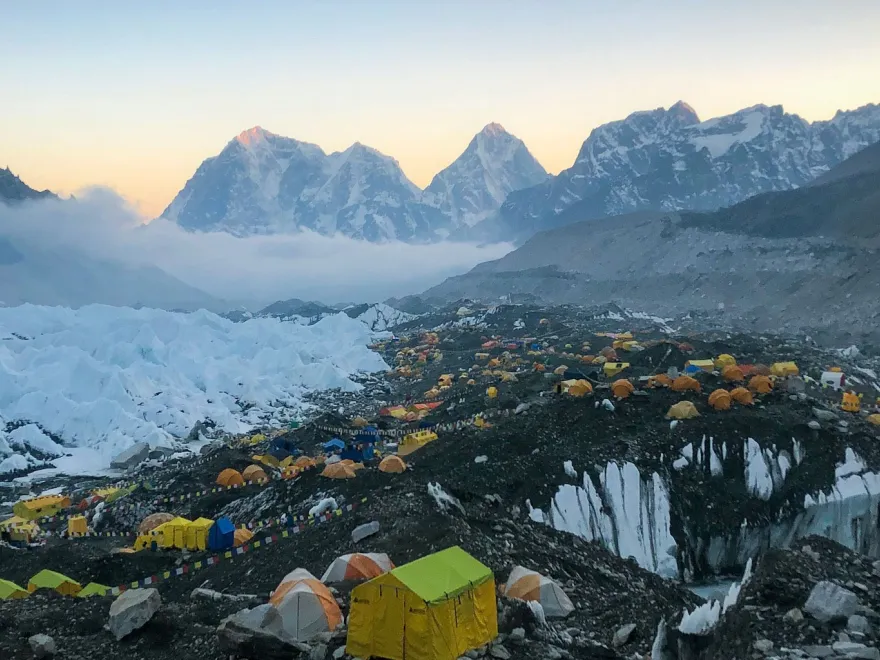
At Base Camp and higher camps, accommodation becomes progressively more basic as the altitude and remoteness increase. Base Camp arrangements commonly involve expedition tents, dining tents, sleeping tents, and shared facilities, while higher camps require specialized high-altitude tents and equipment. Conditions at advanced camps are considerably harsher, with limited space, freezing temperatures, wind exposure, and restricted facilities. Climbers should expect a significant difference between hotel comfort in the cities and the demanding conditions encountered on the mountain.
Expedition meals generally focus on providing sufficient calories, carbohydrates, fats, and protein to support sustained physical effort. Depending on the logistics and camp location, meals may include rice, noodles, soups, porridge, pasta, potatoes, vegetables, and other suitable foods. At higher elevations, appetite often decreases, making hydration and regular energy intake particularly important. Individual dietary requirements, allergies, and preferences should be communicated to the expedition organizer before departure.
Everest Extreme Adventure should confirm the exact accommodation category, meal inclusions, drinking-water arrangements, and the facilities provided at each camp before the expedition begins. Conditions and services may change with weather, altitude, and logistical constraints.
Climbing Mt. Everest from the North (Tibet Side) requires advance authorization and compliance with the applicable Chinese and Tibetan travel, mountaineering, and access regulations. Unlike a standard trekking trip, a North Side Everest expedition involves restricted border-region travel, organized transportation, high-altitude mountaineering permissions, and specific administrative procedures. Requirements may change from year to year, and access can depend on government decisions, seasonal restrictions, route conditions, and the eligibility of individual climbers and expedition operators.
The journey generally begins in Kathmandu, where climbers prepare their travel documents and coordinate the arrangements required for entry into Tibet. Depending on nationality and the rules in effect, travelers may need a valid passport, the appropriate Chinese visa or entry authorization, a Tibet Travel Permit, and other region-specific travel documents. Separate mountaineering permissions and Everest access arrangements are also required for a North Side summit expedition. These permissions are not interchangeable: general travel authorization does not, by itself, grant permission to climb Everest.
Because the North Side route is located in a controlled-access region, climbers should not assume that permits can be obtained independently or at the last minute. The expedition organizer must coordinate with the appropriate authorities and confirm the current rules before travel. Travelers should also ensure that their passport details, application documents, travel dates, and insurance information are consistent across all required submissions.
Everest Extreme Adventure can help coordinate expedition documentation and logistical preparations according to its current services and authorizations. All permit categories, fees, processing times, and eligibility requirements should be verified with the relevant authorities before booking, as approval cannot be guaranteed.
Choosing Mt. Everest from the North (Tibet Side) offers experienced mountaineers a distinctive opportunity to approach the world's highest mountain through the dramatic landscapes of the Tibetan Plateau. The journey combines high-altitude mountaineering with cultural experiences in Lhasa and traditional Tibetan settlements, making it more than a summit attempt alone. Climbers travel through expansive valleys, high mountain passes, and remote landscapes before reaching the northern side of Everest. The North Ridge route presents a demanding mountaineering challenge and provides a different perspective on Everest compared with the more frequently discussed South Side route in Nepal.
With Everest Extreme Adventure, the expedition is planned around the major stages of a long-duration climb, including arrival and preparation, travel to Tibet, acclimatization, equipment checks, climbing rotations, rest periods, and a designated summit window. A structured itinerary helps climbers understand the progression from lower-altitude travel to the increasingly demanding conditions of Base Camp and higher camps. Logistical coordination is particularly important because the expedition takes place in a remote region where transport, permits, supplies, weather, and access arrangements can affect the schedule.
The North Side expedition is most suitable for climbers who already possess substantial mountaineering experience and are prepared for an extended period in severe high-altitude conditions. It requires careful preparation, disciplined decision-making, technical competence, and the ability to adapt when weather or health concerns affect the climbing plan. Although a detailed itinerary can support preparation, no company or guide can guarantee favorable weather, a summit, or a completely risk-free expedition.
Reasons to consider the North Side Everest expedition include:
Everest Extreme Adventure aims to support climbers through careful planning and coordinated expedition logistics. Before confirming a booking, climbers should review the company's current operating authorization, guide and high-altitude staff qualifications, safety procedures, supplemental oxygen arrangements, rescue and evacuation plans, insurance requirements, and the precise services included in the expedition price. These checks help ensure that participants understand both the opportunities and the serious risks involved in attempting Mt. Everest from the North (Tibet Side).
The 60-day Mt. Everest North Side expedition with Everest Extreme Adventure begins in Kathmandu, Nepal, with arrival, document preparation, and expedition arrangements. Climbers then fly to Lhasa, Tibet, to explore its cultural landmarks and acclimatize before traveling through Gyantse, Shigatse, and other spectacular Tibetan landscapes toward Everest Base Camp.
The expedition continues with trekking to Advanced Base Camp, equipment preparation, technical training, and gradual acclimatization through designated camps. Climbers rotate, rest, and follow a carefully planned summit window, depending on weather and mountain conditions. Following the climbing period, the team descends to Base Camp, returns toward the Nepal–China border, and travels back to Kathmandu. The itinerary combines cultural discovery, challenging high-altitude mountaineering, and breathtaking Himalayan scenery, and requires excellent fitness, prior climbing experience, and flexibility for weather-related delays.
The trip officially begins upon your arrival in Kathmandu, Nepal. A transit to Kathmandu makes it easier to obtain a Chinese VISA and the climbing permits. Upon arrival, we’ll greet you outside the airport and drive you to your hotel. Stay in one of the finest hotels overlooking the entire city. Your Sherpa guide will meet you at the hotel and other teammates. He will brief you about the expedition in detail—overnight in Kathmandu.
The day begins with a delicious breakfast. You will spend the day assembling needed gear and equipment. Visit the local outdoor shop around Thamel to buy or rent necessary gears. In the meantime, your guide will visit appropriate agencies to obtain necessary permits, including expedition permits, VISA, garbage disposal, expedition permits, etc.
To help prepare for the upcoming climb, you can visit the local rock-climbing arena. Spend another day indulging in a beautiful sightseeing tour of Kathmandu City. Guided by an experienced tour guide, you will visit some of the most famous UNESCO World Heritage Sites around the city. Overnight in Kathmandu.
The day begins with a delicious breakfast. After packing your bag, you’ll leave for the airport. From Tribhuvan International Airport, you’ll catch a short flight to Lhasa. The beautiful trans-Himalayan flight lasts almost 1.5hr and will take you along some of the highest mountains on Earth, Mount Everest, Makalu, Dorje Lakpa, and Kanchenjunga. Enjoy the scenic view of the sprawling desert-like Tibetan plateau.
Upon arrival in Lhasa, you will get to catch the majestic aerial sight of Potala Palace. Check into one of the finest boutique hotels in the city. In the evening, you can explore the main market of Lhasa. Overnight in Lhasa.
Enjoy a delicious breakfast at the hotel. Embark on an exciting journey around Lhasa City. The tour commences with a visit to the 16th Century fortress, Potala Palace, located atop the Red Hill at the heart of the city. Also known as the winter palace, the Dalai Lama resided in Potala until the late 50s. You will get to witness the Dalai Lama’s private chamber, imperial office, library, and prayer rooms.
Head down from Potala and walk towards the historical Jokhang Temple. The temple dates back to the reign of King Songtsang Gampo in 3rd CE. Explore the beautiful Buddhist temple and witness the pilgrims making circumambulation around the temple. Head outside to explore the majestic Barkhor Street.
Enjoy a delicious lunch before heading to Norbulingka Palace. Also known as the summer palace, the 17th Century palace served as the residence of the former Dalai Lama. Explore the beautiful garden at Norbulingka Palace before heading back to the hotel. Overnight in Lhasa.
Enjoy a delicious breakfast at the hotel. Embark on a rather long road journey through the scenic Tibetan Plateau towards Gyantse valley. Leaving Lhasa, you’ll begin driving south via two high passes towards Karo La Pass. Cross the pass overlooking the spectacular glacier hanging from a snowy peak of Nazin-Kang Sa (7252m). Drive past Kamba La and numerous small settlements to reach Gyantse. Overnight at Gyantse.
Enjoy a delicious breakfast and then embark on a tour of the Pelkor Chode Monastery and Gyantse Kumbum in Gyantse valley. A short drive towards the foothills of Dzong Hill will bring you to Pelkor Chode Monastery. Explore the monastery and then head towards Gyantse Kumbum, a sizeable gold-domed Stupa with numerous chapels.
Afterward, you’ll head back on the road and begin driving towards Xigatse prefecture. Xigatse or Shigatse is the second-largest city in the Tibet Autonomous Region of China. Enjoy a short tour to Tashi-Lunbu Monastery, one of the four monasteries of the Gelug Sect, en route to Xigatse. Overnight at Xigatse
Explore the beautiful Xigatse prefecture, the part of the historical Tsang province of Tibet. From here, you’ll begin driving for almost 270km to reach Xegar. Along the way, you will cross the scenic high passes of Tropu La (4890m) and Gyatso La (5250m). These passes remain inaccessible because of snow almost half of the year. You can make a brief stop at the Sakya Monastery and explore the beautiful sight before driving towards Xegar. Overnight in Xegar.
Leaving Xegar County, you’ll begin driving towards the Everest Base Camp. Xegar connects the famous Nepal-Tibet Friendship Highway that goes along the Rongbuk and Everest Base Camp into Nepal. Begin driving south for almost 90km to reach the majestic Rongbuk Monastery.
Located at 4,980 meters, the 8th Century monastery offers insights into the life of Padmasambhava Guru Rinpoche. Leaving Rongbuk, you’ll begin driving towards Everest Base Camp. Catch the majestic sights of Qomolangma (Mount Everest), Shishapangma, and Makalu North along the way. Overnight in Everest Base Camp.
You’ll wake up early and begin trekking towards the Advanced Base Camp. You do not require a climbing permit to trek through the 22km long trail. The same route is undertaken by climbers attempting to summit Everest through the North Col and the Northeast Ridge. You’ll trek along the Rongbuk River to arrive at the Interim Camp. After a brief rest, you’ll continue climbing uphill along the Changtse Glacier to reach Advanced Base Camp.
You’ll spend a few days at Advanced Base Camp. This will help you to acclimatize to the altitude and thin-air before undertaking the climb. You’ll spend four days preparing for the expedition. Your Sherpa guide will assess your entire equipment and gear. A brief training session will follow with your teammates. Your Sherpa guide will provide you with the necessary training for using ascenders, carabineers, ice-ax, and ropes.
Leaving Advanced Base Camp, you’ll begin to climb down along the Changtse Glacier and head towards Rongbuk Glacier. The easy trail will take you alongside the Rongbuk River towards Interim Camp. As the name suggests, the interim camp lies just between Everest Base Camp and Advanced Base Camp. George Mallory first discovered the trail in 1922. Overnight in a tented camp.
Leaving Interim Camp, you’ll begin climbing the rugged, icy trail towards Advance Base Camp. The base camp lies on a flattened gravel mound next to Changtse glacier. Witness the beautiful snow and rock moraines along the path. A half-day of the trek will bring you to Advance Base Camp. Catch the majestic sight of Mount Everest from the base camp. Overnight in a tent.
After preparing for the climb, you’ll embark on the expedition and begin climbing towards Camp I (7010m). The scenic trail goes through the snow moraine towards North Col. Some section of the climb requires using a fixed rope.
The comparatively safe climb will take you towards North Col., where you’ll make your first camp. Leaving Camp I, you’ll approach the rocky northeast ridge to climb towards Camp II (7775m). A reasonably angled snow slope may prove to be challenging to climb. Camp II site is often windy. Leaving Camp II, you’ll descend back towards the Advanced Base Camp. Overnight in a tent.
Leaving Advance Base Camp, you’ll begin climbing the snowy path towards Camp I. Take the same approach as before and head towards Camp II at the North Col. From the North Col., you’ll make a push towards Camp III. Climb along the North Face and cross the Yellow Band to reach the campsite at Camp III. Catch the beautiful sights of some of the highest mountains, hanging glaciers, and Tibetan plateau en route to Camp III. Overnight in a tent.
You’ll spend some essential days recuperating and acclimatizing before commencing the climb to the summit. You can use these extra days to discuss with your Sherpa guide, ascertain route and difficulty, assess weather conditions, and practice.
After optimum rest, you’ll embark on the climb towards the summit. You’ll make numerous ascents and descents to help acclimatize your body. The route climbs along the Northeast Ridge and goes past Camp I, Camp II, and Camp II towards the summit.
Leaving Camp III, the 8-10 hours long climb goes past the natural snow and rock trail towards Chinese Ladder. Chinese ladder is a ladder placed semi-permanently in 1975 by a party of Chinese climbers, which is virtually used by all climbers on the Northeast Ridge.
After crossing the Second step, you’ll begin climbing towards the Third Step. The altitude rises from 8,690m to 8,800m. After completing the third step, you’ll make your way towards the summit. The final climb encounters a snow slope of 50 degrees.
Upon climbing the summit, you will enjoy the majestic panoramic scenery of the Himalayan giants such as Lhotse, Nuptse, and Ama Dablam. Catch the beautiful view of the sprawling Tibetan plateau from the top. You’ll retrace your path and continue climbing down towards the Camp I.
After clearing the camp, you’ll begin trekking downhill towards Advanced Base Camp. Your staff will follow later with the Yak Caravan. Take a brief rest at Changtse Glacier and enjoy your lunch. Afterward, you’ll begin heading down to Advanced Base Camp. You can choose to head down towards Interim Base Camp. Overnight in a tent.
Retrace your path and head towards the Friendship Highway. Here on, you’ll drive south towards Nepal. The scenic highway goes along the beautiful landscape towards Tingri County. From here, you’ll continue driving past Thorong La to arrive at Paige-Tso Lake. Continue driving along the massive Brahmaputra River to reach Kyirong.
You’ll exit Tibet at Kyirong overlooking the beautiful peaks of Shishapangma, Cho Oyu, Melungtse, and Gauri Shankar. Enter Nepal at the Nepal-China border and continue driving along the forested hills and massive Bhote Koshi River towards Syabrubensi. From here, you’ll make your way towards Kathmandu.
You can choose to spend the rest of the vacation touring Kathmandu or other parts of Nepal. We’ll drop you off at Tribhuvan International Airport on time for your flight back home.
The Mt. Everest North Side expedition organized by Everest Extreme Adventure takes approximately 60 days, depending on weather conditions, permit arrangements, transportation, and climbing progress. The itinerary includes arrival in Kathmandu, document preparation, travel to Lhasa, acclimatization, and an overland journey to Everest Base Camp. Climbers then complete training, acclimatization rotations, higher-camp preparations, and a summit attempt before returning to Kathmandu. Additional days may be required if adverse weather, health concerns, or access restrictions affect the schedule.
Climbing Mt. Everest from the North Side is an extremely challenging mountaineering undertaking requiring excellent physical fitness, technical climbing ability, and extensive high-altitude experience. Climbers face low oxygen levels, severe cold, strong winds, steep snow and ice slopes, exposed terrain, and potential altitude-related illnesses. The expedition also demands mental resilience and careful decision-making over several weeks. Everest Extreme Adventure recommends that participants have substantial previous high-altitude climbing experience and be proficient in using crampons, ice axes, ascenders, fixed ropes, and other essential mountaineering equipment.
The expedition generally begins in Kathmandu, Nepal, where climbers meet the expedition team and prepare travel documents, equipment, and logistical arrangements. After completing the necessary preparations, participants fly to Lhasa, Tibet, and begin a gradual overland journey toward Everest Base Camp. The route typically passes through destinations such as Gyantse, Shigatse, and Tingri or the surrounding Everest region. Everest Extreme Adventure coordinates the planned itinerary according to applicable permits, transportation arrangements, and current Tibet travel regulations.
Climbers should prepare well in advance because Everest requires exceptional endurance, strength, technical competence, and the ability to function under prolonged physical stress. Training should include cardiovascular exercise, uphill hiking with a weighted pack, leg and core strengthening, and appropriate mountaineering practice. Previous experience at high altitude and on technical snow and ice routes is particularly important. Everest Extreme Adventure recommends that prospective participants undertake suitable medical assessments, build their fitness gradually, and gain relevant climbing experience before committing to the expedition. General fitness alone is not sufficient preparation for Everest.
Acclimatization allows the body to adjust gradually to decreasing oxygen availability as elevation increases. The itinerary includes time in Lhasa, travel through progressively higher regions, and additional acclimatization periods at Everest Base Camp and designated climbing camps. Climbers may complete rotations to higher elevations before descending to rest, depending on the expedition plan and mountain conditions. Everest Extreme Adventure emphasizes following the expedition leader's instructions and monitoring symptoms of altitude illness. Severe headache, confusion, breathing difficulties, or worsening symptoms require prompt medical assessment and may necessitate descent rather than continued climbing.
Mt. Everest is not suitable for beginners or people whose only preparation consists of general fitness training or ordinary trekking. The North Side expedition requires substantial high-altitude mountaineering experience, technical climbing skills, sound judgment, and familiarity with extreme environmental conditions. Prospective climbers should first build experience through progressively more demanding mountain objectives and obtain appropriate technical training. Everest Extreme Adventure should assess each participant's climbing background, fitness, and readiness before accepting an expedition booking. Even experienced mountaineers must recognize that Everest presents significant risks and that summit success cannot be guaranteed.
Everest Extreme Adventure offers prospective climbers an organized framework for planning the Mt. Everest North Side expedition, including itinerary coordination, travel logistics, documentation support, acclimatization scheduling, and mountaineering preparations, subject to the services confirmed in the booking agreement. A long-duration expedition requires careful coordination of transportation, accommodation, supplies, climbing equipment, and weather-dependent decisions. Before choosing the company, climbers should verify its current operating authorizations, guide qualifications, high-altitude support arrangements, safety procedures, oxygen provisions, emergency response plans, and detailed package inclusions. Careful preparation and transparent communication are essential for understanding the demands and risks of attempting the world's highest mountain.
Climbers need specialized equipment suitable for extreme cold, high winds, technical snow and ice climbing, and prolonged exposure at high altitude. Essential personal gear generally includes insulated mountaineering boots, crampons, an ice axe, a climbing harness, a helmet, suitable technical clothing, expedition-grade down layers, gloves, goggles, a sleeping system, and personal medical supplies. Technical equipment and oxygen systems must meet the expedition's specifications. Everest Extreme Adventure should provide a detailed equipment checklist before departure, clarifying which items climbers must supply themselves and which equipment, if any, is provided by the expedition operator.
Supplemental oxygen is commonly used during high-altitude climbing on Everest, particularly above 8,000 meters, where oxygen availability is critically low. The oxygen strategy depends on the expedition plan, individual needs, equipment arrangements, and the decisions of qualified climbing personnel. Climbers must understand the use of oxygen systems, regulators, masks, and emergency procedures before ascending to higher camps. Everest Extreme Adventure should clearly explain its supplemental oxygen provisions, backup supplies, equipment maintenance, and emergency protocols before departure. Supplemental oxygen reduces some effects of altitude but does not eliminate the serious risks of climbing Everest.
Comprehensive insurance is strongly recommended for anyone attempting Mt. Everest from the North (Tibet Side). Ordinary travel insurance frequently excludes high-altitude mountaineering, so climbers should carefully verify that their policy explicitly covers Everest climbing at the intended elevation, emergency medical treatment, helicopter evacuation where available, mountain rescue, and repatriation. Coverage limits, exclusions, and geographical restrictions require particular attention. Everest Extreme Adventure should communicate its insurance requirements before the expedition begins. Climbers should also understand that rescue services at extreme altitude may be limited by weather, terrain, accessibility, and operational restrictions.
Spring, particularly April and May, is generally considered the main climbing season for Mt. Everest from the North (Tibet Side). During this period, climbers typically prepare for summit attempts when weather forecasts indicate suitable conditions. However, extreme cold, high winds, snowfall, and changing mountain conditions can affect the climbing schedule. Everest Extreme Adventure recommends planning well in advance and maintaining flexibility throughout the expedition, as reaching the summit depends on safe weather windows, route conditions, and individual health.
Weather delays are common on Mt. Everest, where strong winds, snowfall, extreme cold, and unstable conditions can make climbing unsafe. The itinerary includes a designated summit period, but the actual ascent depends on suitable weather forecasts, route conditions, climber health, and the expedition leader's assessment. Rest days or additional acclimatization periods may be needed, and the summit attempt may be postponed or abandoned if conditions deteriorate. Everest Extreme Adventure should explain its contingency arrangements, schedule flexibility, and policies concerning delays or unsuccessful summit attempts before booking. Reaching the summit can never be guaranteed.
Transportation generally includes the planned journey from Kathmandu to Lhasa by air, followed by road travel through Tibet toward Everest Base Camp. The overland route typically passes through scenic Himalayan landscapes and Tibetan towns such as Gyantse and Shigatse. Depending on the itinerary and access arrangements, vehicles transport climbers and expedition supplies along designated roads, while trekking and mountaineering are required beyond accessible vehicle points. Everest Extreme Adventure should confirm which domestic flights, road transfers, baggage arrangements, and border-related transportation are included in the package, as schedules and access conditions may change.
Climbing Mt. Everest from Tibet requires appropriate travel authorization and specific mountaineering permissions. Depending on nationality and current regulations, climbers may need a valid passport, the applicable Chinese visa or entry authorization, Tibet travel permits, restricted-area access permissions, and an Everest climbing permit. Requirements and approval procedures can change, so travelers should confirm the latest regulations before departure. Everest Extreme Adventure can coordinate relevant documentation according to its current services and authorizations, but travelers should verify the exact permit requirements, fees, and processing times in advance.
Accommodation varies throughout the Mt. Everest North Side expedition. In Kathmandu and Lhasa, climbers generally stay in hotels, while accommodation in Tibetan towns may consist of hotels or guesthouses, depending on availability. At Everest Base Camp, accommodation typically involves expedition tents and shared dining facilities. Higher camps require specialized mountaineering tents designed for extreme conditions, with more limited space and facilities. Everest Extreme Adventure should confirm the accommodation standards, room arrangements, camping equipment, and facilities included in the expedition package before booking.
Food arrangements depend on the location and stage of the expedition. In Kathmandu and Lhasa, meals may be available at hotels and local restaurants, while overland stops generally offer meals through local accommodation providers or restaurants. At Base Camp and higher camps, expedition meals commonly include foods such as rice, noodles, soups, porridge, pasta, and other energy-rich options, depending on logistics and altitude. Everest Extreme Adventure should confirm which meals are included in the package and whether special dietary requirements, drinking water, and food supplies for higher camps are covered.
| No of people | Price per person |
|---|---|
| 1 - 1 | $1,999 |
| 2 - 4 | $1,775 |
| 5 - 9 | $1,755 |
| 10 - 15 | $1,735 |
| 16 - 20 | $1,715 |
| No of people | Price per person |
|---|---|
| 1 - 1 | $6,050 |
| 2 - 4 | $5,700 |
| 5 - 9 | $5,650 |
| 10 - 15 | $5,600 |
| 16 - 20 | $5,550 |