Group Adventure Dates.  4.9 of 489 reviews
 4.8 of 232 reviews
4.9 of 489 reviews 4.8 of 232 reviews 
Experience an unforgettable Himalayan adventure with Everest Extreme Adventure, trekking from Phaplu through remote Sherpa villages and alpine valleys to summit Mera Peak at 6,458m. Enjoy spectacular views, authentic mountain culture, challenging trails, acclimatization, and an exhilarating high-altitude climbing experience.
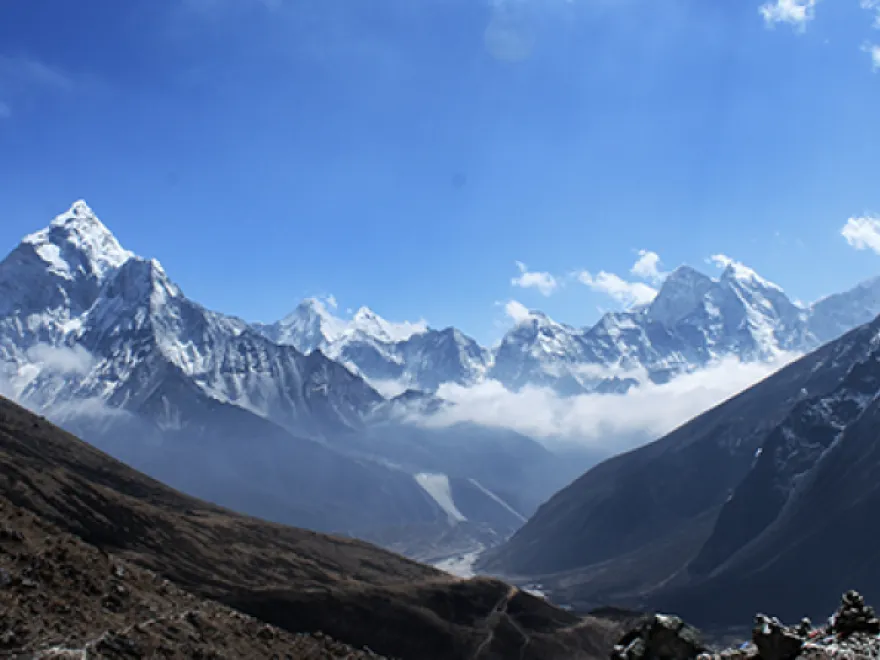
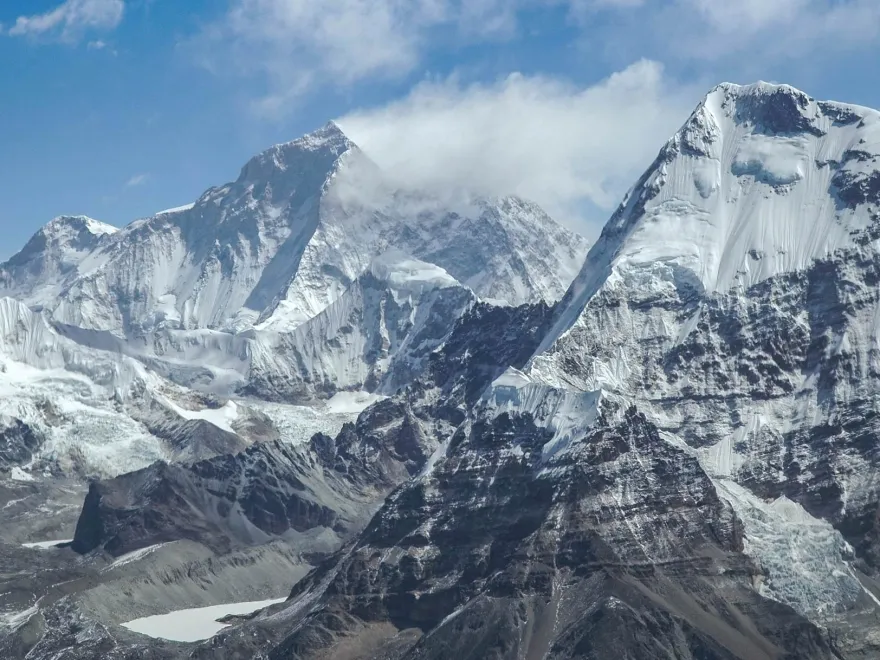
Enjoy an adventurous climb of the highest trekking peak in Nepal. Located at the sheer altitude of 6,458 meters, Mera Peak is the highest permitted trekking peak in the country. Explore the pristine Barun and Hinku Valley along the offbeat trail beginning from Phaplu village. Catch the majestic sights of Mount Everest, Nuptse, Cho Oyu, Lhotse, Makalu, and Kanchenjunga Peaks.
Mera Peak was first summited by Col. Jimmy Roberts and Sen Tenzing in 1953 AD. Since then, thousands of climbing enthusiasts have summited the peak. It is home to three different peaks, namely Mera North (6476m), Mera Central (6458m), and Mera South (6065m).
The moderate trek route, accessible ridges, and rock wall offer trekkers a good chance of successfully summiting the peak. The pristine peak lies inside Barun and Hinku Valley, an offbeat trail located just beside the populous Everest Base Camp trail.
The trip is well guided by an experienced Sherpa guide who will prepare you for the climb. You’ll embark on a 30-min flight towards Phaplu in Solukhumbu District. You’ll walk through the pristine natural settings inside Makalu Barun National Park en route to Mera Peak.
Explore the beautiful villages of Kharikhola, Pangkongma, Ramailo Danda, Chatra Khola, Kothe, Thagnak, and Khare. You’ll camp throughout the trail which, rises to Mera High Camp (5780m). The ascent encounters steep; isolated ridges angled almost 45-50 degrees. Using the fixed rope, you’ll climb the snow and ice wall towards the lower south summit.
Enjoy the panoramic view of Mount Everest, Makalu, Lhotse, Cho Oyu, Baruntse, and Kanchenjunga. The trail begins to descend through Kothe towards Zatrwa La Pass. Cross the mighty pass to head towards the Dudh Koshi Valley. The trek concedes upon your arrival in Lukla.
Embark on adventurous 19-day Phalpu to Mera Peak Trek with Everest Extreme Adventure. We specialize in full-board expedition trips to different mountain peaks around Nepal and Tibet. You can choose to join a fixed group or departures. Our Sherpa leaders have led a countless number of expeditions to Everest.
The Phaplu to Mera Peak trek is an adventurous and rewarding Himalayan journey that combines remote trekking, high-altitude acclimatization, and the exciting challenge of climbing Mera Peak (6,458 m). Organized by Everest Extreme Adventure, this itinerary begins with arrival and preparation in Kathmandu before a scenic flight to Phaplu. From Phaplu, the trail passes through traditional Sherpa settlements, lush hills, forests, ridges, and remote mountain valleys before reaching the high-altitude areas around Thangnak and Khare. Compared with the more commonly used Lukla approach, the Phaplu route offers a quieter and more gradual journey into the Mera Peak region.
The itinerary is designed with dedicated acclimatization days at Thangnak and Khare, followed by preparation for the summit climb. After reaching High Camp at approximately 5,780 m, the summit day involves an early start and a long climb to the summit of Mera Peak before descending toward Khare. The return journey continues through Kothe, Zatrwa, and Lukla, followed by a flight back to Kathmandu.
The best seasons for the Phaplu to Mera Peak climbing itinerary are generally spring (March to May) and autumn (September to November). During these periods, the Himalayan weather is usually more stable, with better visibility and comparatively favorable conditions for trekking and climbing. Spring brings pleasant daytime temperatures, blooming rhododendrons, and excellent mountain scenery, while autumn is known for clear skies, crisp mountain views, and relatively stable conditions following the monsoon.
Although experienced climbers may consider other months, winter can bring extremely cold temperatures, snowfall, and challenging conditions at higher elevations. The monsoon season can make lower trails wet and slippery and may also cause flight disruptions. For a high-altitude expedition such as Mera Peak, selecting an appropriate season is particularly important because weather conditions can directly affect summit safety and transportation.
The Phaplu to Mera Peak itinerary is considered a challenging high-altitude trekking and climbing adventure. The difficulty comes not only from the duration of the trek but also from the progressive increase in elevation. Trekkers encounter long walking days, steep ascents and descents, rugged mountain trails, and thin air. The summit day is particularly demanding, with an ascent to 6,458 m followed by a descent to Khare. Previous trekking experience and good physical preparation are highly recommended.
Transportation is an important part of the journey. The itinerary starts with a flight from Kathmandu to Phaplu, from where the trekking section begins. After the summit and descent, the route continues toward Lukla, where the group takes a flight back to Kathmandu. Mountain flights are weather-dependent, so travelers should maintain some flexibility in their schedule. Everest Extreme Adventure can assist with the necessary logistical arrangements and coordinate transportation as part of the overall expedition plan.
Food and accommodation on the Phaplu to Mera Peak trek are based mainly on local mountain lodges, teahouses, and camping arrangements. During the lower and mid-altitude trekking sections, travelers generally stay in comfortable local lodges and teahouses. These provide a simple but authentic Himalayan experience and allow trekkers to interact with local communities. As the route climbs toward Thangnak, Khare, and High Camp, facilities become increasingly basic, and camping may be required depending on the conditions and expedition arrangements.
Meals are designed to provide sufficient carbohydrates, protein, and energy for long trekking and climbing days. Common meals in the region include dal bhat, rice, vegetables, noodles, pasta, potatoes, soups, eggs, bread, and other simple local or international dishes. At higher elevations, food choices can be more limited because supplies have to be transported along the mountain route. Proper hydration is also essential throughout the trek, particularly during acclimatization and summit preparation.
The Phaplu to Mera Peak journey requires appropriate trekking and mountaineering permits because it enters protected and regulated Himalayan areas and involves climbing a recognized trekking peak. The exact permits and fees can vary according to current Nepal government regulations, local area requirements, and the climbing season. Everest Extreme Adventure can coordinate the required documentation and permit arrangements before the expedition begins.
Trekkers should ensure that their permits and official documentation are properly arranged before entering the relevant trekking and climbing areas. In addition to peak-climbing authorization, the journey may involve conservation or national park-related permits and local entry requirements. Because regulations and fees can change, travelers should confirm the current requirements with their trekking agency before departure.
Choosing the Phaplu to Mera Peak route with Everest Extreme Adventure provides an opportunity to experience a less-traveled approach to one of Nepal's most popular trekking peaks. The itinerary combines remote Himalayan trekking with gradual acclimatization and a structured summit attempt. Instead of rushing directly toward the higher elevations, the journey progressively moves through different landscapes and elevations, allowing participants to experience the changing environment from lower valleys to alpine terrain.
Everest Extreme Adventure can support the expedition with trekking and climbing logistics, accommodation arrangements, permits, transportation coordination, and experienced mountain staff. The itinerary also includes dedicated acclimatization and preparation days at Thangnak and Khare, which are important components of a high-altitude climbing program. For travelers seeking a combination of cultural immersion, remote trekking, mountain adventure, and a Himalayan summit experience, the Phaplu approach to Mera Peak offers a memorable and comprehensive expedition.
The Phaplu to Mera Peak itinerary with Everest Extreme Adventure is a thrilling 19-day Himalayan adventure combining remote trekking, cultural exploration, acclimatization, and peak climbing. The journey begins in Kathmandu with preparation before a scenic flight to Phaplu. From there, the trail passes through Taksindu, Kharikhola, Pangkongma, Ramailo Danda, Chatra Khola, Kothe, and Thangnak before reaching Khare, the main base for the Mera Peak climb.
After acclimatization and climbing preparation, the expedition ascends to High Camp and continues toward the summit of Mera Central (6,458 m). Following the summit, trekkers descend through Kothe and Zatrwa to Lukla before flying back to Kathmandu. Along the way, enjoy spectacular Himalayan scenery, traditional Sherpa culture, remote valleys, and an unforgettable high-altitude climbing experience.
Welcome to Nepal! The trip officially begins upon your arrival in Kathmandu. We’ll pick you up at Tribhuvan International Airport and drive you to the hotel located at the heart of the city. Enjoy a scenic drive along the bustling streets of Kathmandu. Your Sherpa guide will welcome you to the hotel. He will brief you about the trip in detail. Overnight in Kathmandu.
The day begins with a delicious breakfast. Today, you’ll prepare for the upcoming trip. Visit the local outdoor gear shops to buy or rent necessary climb gear and equipment. Your guide can help you strike a better deal. In the meantime, he will visit appropriate government offices to obtain the climbing permit. You can consider visiting the local rock-climbing arena to improve your stamina before the trip begins. Overnight in Kathmandu.
Enjoy breakfast and then drive towards the airport. You’ll embark on a 30-min long flight from Kathmandu to Phaplu village. Enjoy the pristine aerial tour of Kathmandu and Everest Region. Upon arrival, you’ll prepare your bags and then embark on the first day of the trek. The trail begins to head east along the Numbur towards Taksindu La Pass (3100m). Catch the majestic sights of Thamserku (6623m), Kantega (6780m), Kusum Kanguru (6370m), and Mera Peak (6650m) from the top.
Leaving Taksindu, you’ll begin climbing down towards the small town of Nunthala (2200m). Walk past small Sherpa settlement and along the majestic Dudh Koshi River towards Jubing (1680m). The trail continues past barley, corn, and wheat fields towards Khari Khola (2010m). Overnight in Kharikhola.
Leaving Kharikhola, the trail begins to rise eastward and leave the standard Everest trail. Instead of heading north, you’ll continue straight through the southeastern trail and climb along the forested path towards Lenjikharka. The trail further rises for a few hours and heads towards the remote village of Pangkongma (2846m). Overnight inside a teahouse.
Leaving Pangkongma, you’ll begin climbing towards the mountainous pass of Pangkongma La (3174m). A few hours of the uphill trek along the Rhododendron and pine forests will bring you to the top. You’ll exit the Dudh Koshi Valley and begin traversing into Hinku Valley. Catch the natural sights of the Dudh Koshi River and Hinku Khola en route. Enjoy a short trek overlooking the majestic views of Mera Peak, Sanu Himal, Mojang Himal, and Mera Himal towards
Leaving Ramailo Danda, you’ll begin trekking a steep trail towards Chatra Khola. The trail further climbs towards the high point at 3,350 meters. Enjoy a scenic view before climbing down towards the river. After a brief lunch break, you’ll begin climbing through the deep ravines towards Chatra Khola. Overnight at Teahouse.
Leaving Chatra Khola, you’ll embark on the half-day long trek towards Kothe Village. The trail begins to climb upstream along the Hinku Khola and enters the moss-covered forest. Navigate along the crooked ridges and reach a sandy boulder-choked area at Kothe. Kothe village lies at an altitude of 3,600 meters. Overnight at Teahouse.
Leaving Kothe, you’ll begin climbing along the west bank of the Hinku Khola. The trail gives way to the dense forest, which takes you towards Upper Hinku. Walk past small yak pastures or Kharka overlooking the twin summits of Kusum Kanguru on the left.
Continue climbing through the sharp V of the valley towards Gondishung. Enjoy a delicious lunch before continuing along the trail. The trail begins to climb past Mani walls towards Thangnak village. Overnight at Teahouse.
Enjoy a beautiful day at Thangnak. You can spend the day acclimatizing or even exploring the beautiful Himalayan valley. You can make a short trek towards nearby areas. Spend the rest of the day journey up the valley—overnight in Thangnak.
Leaving Thangnak, you’ll begin trekking uphill along the snow-clad region towards Dig Glacier. The trail climbs over Dig Kharka that offers the beautiful sight of Charpate Himal. Begin climbing along the snow moraines towards Hinku Nup and Shar Glaciers. A short climb will bring you to the campsite at Khare overlooking the Mera Peak
Enjoy the morning with a delicious breakfast. You’ll spend the day acclimatizing at Khare village. Before heading up, you’ll spend the day preparing for the upcoming climb. Make a short hike through the Mera Glacier towards Mera La. Spend the rest of the day indulging in training with your Sherpa guide. Overnight in Khare.
Leaving Khare, you’ll begin climbing through Mera Glacier towards Mera Base Camp. After a brief rest, the trail continues to climb along with the fresh snow and crevasses towards the rock band. Marked by a large cairn, you’ll cross the rock band and climb towards the high camp for the overnight stay. Spend the rest of the day acclimatizing at High Camp overlooking the majestic sights of Mount Everest, Makalu, and Cho Oyu. Overnight in a tent camp.
Today is the most challenging day of this trip. You’ll wake up around 2 in the morning and have your breakfast. As your staff prepares to lay fixed ropes, you’ll make your backpack and begin climbing. The entire climb and descent will last almost 7 hours.
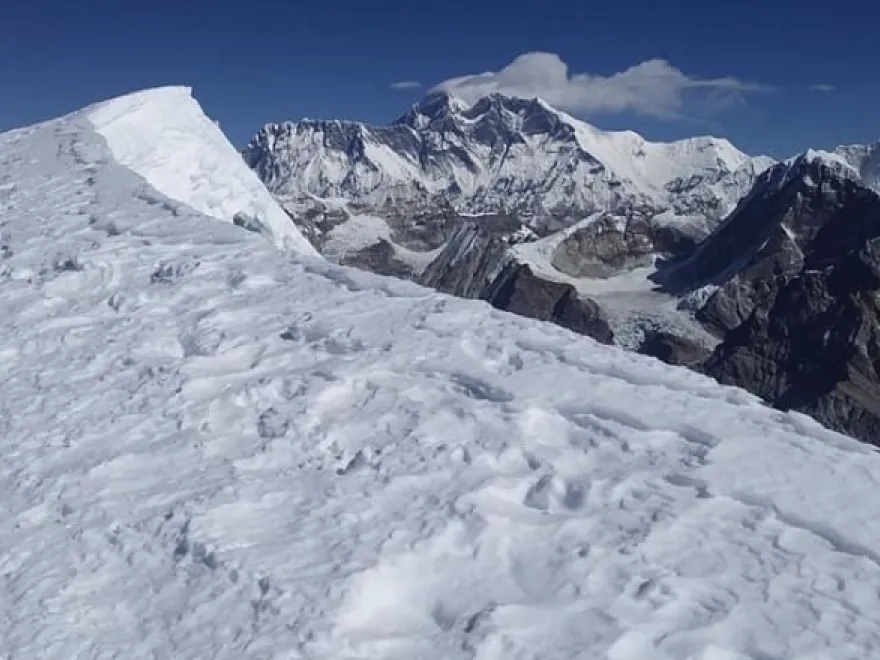
Begin climbing the natural angled snow slopes towards the foot of the dome. Next, climb the fixed rope for the last 30 to 40 meters to reach the top. The final ascent encounters a sharp ridge angled at 45 – 50 degrees.
Enjoy the majestic panorama of the beautiful mountains such as Everest, Lhotse, Baruntse, Makalu, and Kanchenjunga. Retrace your path and begin climbing down towards the high camp. Begin descending towards Mera La Pass and cross over the pass to head towards Khare village. Overnight in a teahouse.
Leaving Khare village, you’ll begin climbing southwest along with the dense alpine forests towards Kothe Village. Walk past beautiful rhododendron forests and head towards the terraced fields at Thangnak. Enjoy a short trek downstream along the Pangram Pokhari towards Kothe Village. Overnight in a teahouse.
Leaving Kothe, you’ll begin climbing the forested path that heads towards Taktho village. Upon crossing the Hinku River, you’ll start trekking along the pristine Buddhist Chorten towards Thuli Kharka. Enjoy a delicious lunch before climbing towards the high pass of Zatrwa-La. (4610m). Overnight in Zatrwa La.
On the last day of the trek, you’ll leave Zatrwa La Pass and begin climbing down towards the Dudh Koshi River. The scenic trail goes past beautiful Sherpa villages along the Dudh Koshi River towards Lukla. Celebrate the completion of the trip with your team leader and staff—overnight in Lukla.
Wake up early and catch the flight back to Kathmandu. A scenic 25-min long flight from Lukla will take you over the lush hills and rivers of Eastern Nepal towards Kathmandu City. Upon arrival, you’ll drive back to the hotel. Enjoy a delicious breakfast. You can relax at the hotel or explore the city today. Overnight in Kathmandu.
Today is the last day in Kathmandu. You can choose to visit a few of the tourist destinations before driving back to the airport. We’ll drop you off approximately 2 hours before your flight time.
The Phaplu to Mera Peak itinerary is a 19-day Himalayan trekking and climbing adventure organized by Everest Extreme Adventure. The journey begins with a flight from Kathmandu to Phaplu and continues through remote villages, forests, valleys, and high-altitude landscapes before reaching Khare. After acclimatization and climbing preparation, the itinerary includes a summit attempt of Mera Central at 6,458 meters before descending toward Lukla and flying back to Kathmandu.
The Phaplu to Mera Peak adventure is considered challenging because it combines multi-day trekking with high-altitude mountaineering. Trekkers need to manage long walking days, steep ascents, rugged trails, cold temperatures, and reduced oxygen at higher elevations. The summit day is particularly demanding, involving approximately 8–10 hours of climbing and descending. Good physical fitness, endurance, mental preparation, and previous trekking experience are strongly recommended.
The highest point of the itinerary is the Mera Peak summit at 6,458 meters (21,187 feet). Before reaching the summit, trekkers gradually gain altitude through Thangnak, Khare, and High Camp. The itinerary includes acclimatization and rest days to help the body adjust to the increasing elevation. Proper pacing, hydration, nutrition, and following the guidance of experienced climbing staff are important for managing high-altitude conditions.
The complete itinerary takes 19 days, beginning with arrival in Kathmandu and ending with departure from Kathmandu. The schedule includes trip preparation, the flight to Phaplu, trekking through remote Himalayan settlements, acclimatization days, climbing preparation, the Mera Peak summit attempt, descent toward Lukla, and the return flight to Kathmandu. Everest Extreme Adventure structures the itinerary with gradual altitude gain and rest periods to support a safer and more enjoyable expedition.
The trekking section starts at Phaplu, following a flight from Kathmandu. From Phaplu, the route passes through Taksindu, Kharikhola, Pangkongma, Ramailo Danda, Chatra Khola, Kothe, Thangnak, and Khare before the Mera Peak climbing section. After completing the summit attempt, the route descends toward Kothe, Zatrwa, and Lukla. From Lukla, travelers take a flight back to Kathmandu, completing the mountain portion of the adventure.
Previous mountaineering experience is helpful but does not necessarily mean you must have climbed a major Himalayan peak before. However, Mera Peak involves glacier travel, snow, steep terrain, cold temperatures, and high altitude, so participants should have good fitness and trekking experience. Everest Extreme Adventure can provide guidance and climbing support during the expedition. Familiarity with basic mountaineering skills and appropriate preparation can make the summit experience considerably more comfortable and rewarding.
The route offers spectacular views of some of the world's most famous Himalayan peaks, depending on weather and visibility. Trekkers may enjoy impressive views toward Mount Everest, Lhotse, Makalu, Kanchenjunga, and numerous surrounding peaks. The journey also provides changing landscapes ranging from green valleys and forests to rugged alpine terrain and snow-covered mountains. The panoramic scenery becomes especially impressive from higher elevations and during the approach to Mera Peak.
Choosing Everest Extreme Adventure for the Phaplu to Mera Peak expedition provides support for trekking, climbing logistics, transportation, accommodation, permits, acclimatization, and summit preparation. The carefully structured itinerary allows travelers to experience remote Himalayan communities while progressively gaining altitude. With dedicated acclimatization days, experienced mountain support, and a combination of lodge and camping arrangements, the company aims to provide a well-organized and memorable journey to the summit of Mera Peak.
The best seasons for the Phaplu to Mera Peak adventure are generally spring (March to May) and autumn (September to November). These months usually offer more stable weather, clearer mountain views, and favorable trekking and climbing conditions. Spring provides beautiful vegetation and blooming rhododendrons, while autumn is particularly popular for clear skies and excellent Himalayan visibility. Winter and monsoon seasons can bring more challenging weather and trail conditions.
The Phaplu to Mera Peak expedition requires the appropriate trekking, conservation or protected-area documentation, local entry permissions where applicable, and a Mera Peak climbing permit. Permit requirements, regulations, and fees can change depending on government policies and climbing seasons. Everest Extreme Adventure assists with the necessary permit arrangements and expedition documentation so that trekkers can concentrate on preparation, acclimatization, trekking, and climbing rather than handling complicated administrative procedures themselves.
Accommodation during the Phaplu to Mera Peak journey includes local mountain lodges, teahouses, and camping. Lower-altitude sections generally provide lodge or teahouse accommodation with basic rooms and shared facilities. At higher elevations, facilities become simpler, and camping may be used according to the itinerary and climbing conditions. High Camp requires camping because of its remote alpine location. Everest Extreme Adventure coordinates the accommodation arrangements throughout the trekking and climbing journey.
Meals during the trek generally include nutritious and energy-rich local and international options such as dal bhat, rice, vegetables, noodles, pasta, potatoes, soup, eggs, bread, and other simple dishes. Food choices may become more limited at higher elevations because supplies must be transported into remote mountain areas. Maintaining adequate hydration and consuming sufficient calories are important during long trekking days and especially during summit preparation and the Mera Peak climbing day.
| No of people | Price per person |
|---|---|
| 1 - 1 | $2,595 |
| 2 - 4 | $2,455 |
| 5 - 9 | $2,435 |
| 10 - 15 | $2,415 |
| 16 - 20 | $2,395 |
| No of people | Price per person |
|---|---|
| 1 - 1 | $2,395 |
| 2 - 4 | $2,270 |
| 5 - 9 | $2,250 |
| 10 - 15 | $2,230 |
| 16 - 20 | $2,210 |